

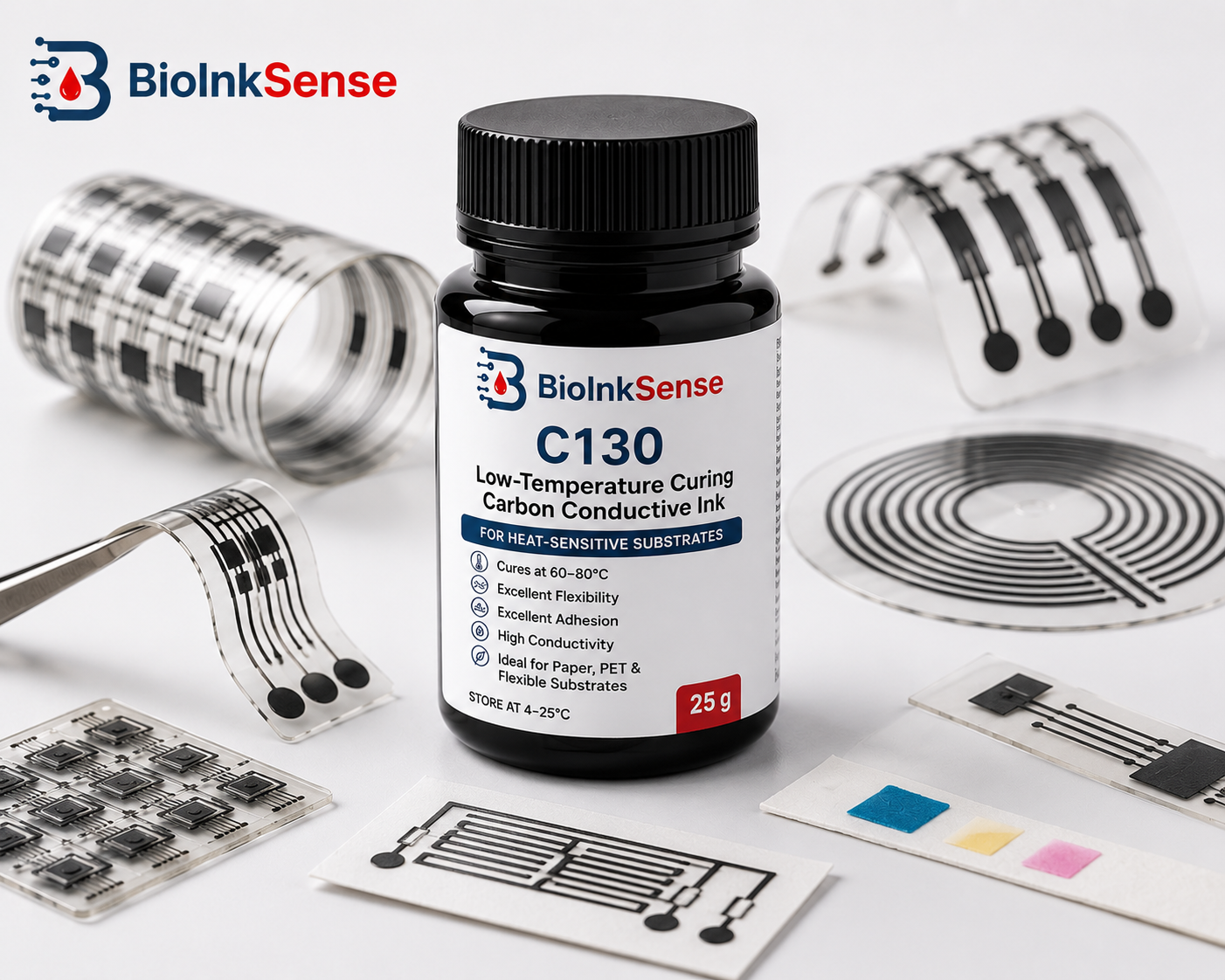
BioInkSense™ C130 Low-Temperature Curing Carbon Conductive Ink
Price range: $149.00 through $3,849.00
High-performance screen-printable carbon conductive ink engineered for heat-sensitive substrates requiring excellent electrical conductivity with curing temperatures as low as 60–80°C. Ideal for flexible electronics, paper diagnostics, disposable biosensors, and temperature-sensitive polymer films.
Description
Description
BioInkSense™ C130 Low-Temperature Curing Carbon Conductive Ink
BioInkSense™ C130 is a high-performance low-temperature curing carbon conductive ink engineered for fabrication of electrochemical biosensors, flexible electronics, disposable diagnostic devices, and printed sensors on heat-sensitive substrates. The formulation enables excellent electrical conductivity while curing at significantly lower temperatures than conventional conductive inks, reducing thermal stress and expanding compatibility with temperature-sensitive materials.
The optimized carbon-polymer system provides excellent printability, superior substrate adhesion, and highly reproducible electrochemical performance without requiring elevated curing temperatures. C130 is particularly suitable for paper-based diagnostics, polymer microfluidics, disposable healthcare devices, wearable sensors, and large-scale roll-to-roll manufacturing where low thermal processing is essential.
The formulation is optimized for fabrication of working electrodes used in amperometric, voltammetric, potentiometric, and electrochemical impedance sensors.
Technical Specifications
| Property | Typical Value |
|---|---|
| Ink chemistry | Low-temperature graphite/carbon composite |
| Printing method | Screen printing |
| Mesh compatibility | 200–420 mesh |
| Recommended emulsion thickness | 10–20 μm |
| Wet film thickness | 12–25 μm |
| Cured film thickness | 5–12 μm |
| Recommended curing temperature | 60–80°C |
| Recommended curing time | 10–15 min |
| Solid content | 65–75 wt% |
| Viscosity (25°C) | 8,000–18,000 cP |
| Particle size (D90) | <10 μm |
| Density | 1.3–1.6 g/cm³ |
| Shelf life | 12 months |
| Storage temperature | 4–25°C |
Electrical Performance
| Parameter | Typical Value |
|---|---|
| Sheet resistance | <15 Ω/sq @ 10 μm cured film* |
| Volume resistivity | <0.015 Ω·cm* |
| Batch-to-batch conductivity variation | <5% |
| Print-to-print reproducibility | CV <3% |
| Contact resistance variation | <5% |
| Adhesion | ASTM D3359 Class 5B |
| Electrical stability | >95% conductivity retained after 2,000 bending cycles |
*Measured under recommended printing and curing conditions.
Electrochemical Performance
| Parameter | Typical Value |
|---|---|
| Electrochemical window | −0.6 to +1.0 V (vs Ag/AgCl) |
| Peak-to-peak separation (5 mM Fe(CN)₆³⁻/⁴⁻, 100 mV/s) | <85 mV |
| Background current | <0.4 μA/cm² |
| Electrode-to-electrode reproducibility | CV <4% |
| Signal stability | >99% after 100 continuous measurements |
| Compatible techniques | CV, DPV, SWV, CA, EIS, OCP |
Mechanical Performance
| Parameter | Typical Value |
|---|---|
| Minimum bending radius | <4 mm |
| Flexibility | Excellent |
| Tape adhesion | ASTM D3359 Class 5B |
| Abrasion resistance | High |
| Chemical compatibility | PBS, serum, saliva, sweat, urine, aqueous buffers |
Compatible Substrates
- Polyethylene terephthalate (PET)
- Polyester
- Polycarbonate
- Polyimide
- Paper
- Cellulose-based substrates
- Flexible polymer films
- Surface-treated plastics
Manufacturing Compatibility
- Manual screen printing
- Semi-automatic screen printing
- Fully automatic screen printing
- Roll-to-roll manufacturing
- Sheet-fed production
Typical Applications
- Paper-based biosensors
- Disposable diagnostic devices
- Flexible electrochemical sensors
- Printed microfluidics
- Wearable biosensors
- Printed electronics
- Flexible circuits
- Point-of-care diagnostics
- Environmental monitoring
- Food safety testing
Quality Assurance
Each production batch undergoes comprehensive quality control including rheological characterization, electrical conductivity testing, electrochemical performance verification, low-temperature curing validation, adhesion testing, printability assessment, visual inspection, and batch-to-batch reproducibility analysis.
Available Documents
- Technical Data Sheet (TDS)
- Safety Data Sheet (SDS)
- Printing Guide
- Storage and Handling Guide
- Certificate of Analysis (available upon request)
Ordering
Select the desired package size and quantity from the purchase options above. Product pricing and availability are updated automatically based on the selected package size.
Additional information
| gram | 10 g, 25 g, 50 g, 100 g, 250 g, 500 g |
|---|
Related products
-
BioInkSense™ S130 Low-Temperature Curing Silver Conductive Ink
Price range: $109.00 through $4,739.00Select options This product has multiple variants. The options may be chosen on the product page -
BioInkSense™ C160 Carbon Nanotube (CNT)-Enhanced Conductive Ink
Price range: $149.00 through $4,599.00Select options This product has multiple variants. The options may be chosen on the product page -
BioInkSense™ D100 Screen-Printable Dielectric Ink
Price range: $79.00 through $2,699.00Select options This product has multiple variants. The options may be chosen on the product page -
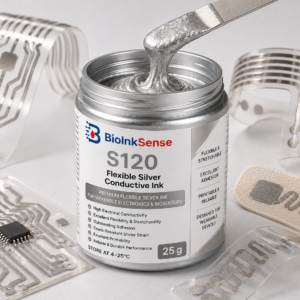
BioInkSense™ S120 Flexible Silver Conductive Ink
Price range: $139.00 through $4,899.00Select options This product has multiple variants. The options may be chosen on the product page